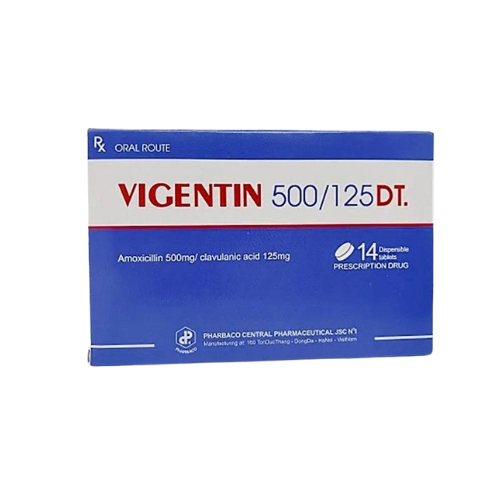
VIGENTIN 875/125 DT
What is Vigentin 875mg/125mg DT Dispersible Tablet?
Vigentin 875mg/125mg DT is an antibiotic commonly used to treat bacterial infections. Its main ingredients include two active substances:
-
Amoxicillin: A penicillin-group antibiotic that kills disease-causing bacteria.
-
Clavulanic acid: A beta-lactamase inhibitor that protects amoxicillin from being destroyed by bacterial enzymes, thereby enhancing treatment effectiveness.
Ingredients
Ingredients
- Amoxicillin (as Amoxicillin trihydrate): 875 mg
- Clavulanic acid (as Potassium Clavulanate combined with Microcrystalline Cellulose in a 1:1 ratio): 125 mg
- Excipients: Aerosil R200, magnesium stearate, aspartame, orange flavoring powder for 1 tablet.
Uses of Vigentin 875mg/125mg DT
Indications (What is this medicine used for?)
- The medication is used for short-term treatment (less than 14 days) of bacterial infections caused by beta-lactamase–producing strains that do not respond to single aminopenicillin therapy.
- Severe upper respiratory tract infections: Tonsillitis, sinusitis, otitis media that did not improve with common antibiotics.
- Severe lower respiratory tract infections caused by beta-lactamase–producing H. influenzae and Moraxella catarrhalis: Acute and chronic bronchitis, bronchopneumonia.
- Severe urinary and genital tract infections caused by beta-lactamase–producing sensitive strains of E. coli, Klebsiella, and Enterobacter: Cystitis, urethritis, pyelonephritis (female genital infections).
- Skin and soft tissue infections: Boils, insect bites, abscesses, wound infections, cellulitis.
- Bone and joint infections: Osteomyelitis.
- Dental infections: Dental abscess.
- Other infections: Post-abortion infections, postpartum infections, intra-abdominal infections.
Dosage and administration
Administration
- Taken orally. It can be swallowed with water but is usually dispersed in a glass of water before use.
Dosage
Adults and children over 40 kg:
-
1 tablet 500 mg (500 mg/125 mg) every 12 hours.
-
For severe infections and respiratory infections: 1 tablet 875/125 mg every 12 hours.
Elderly:
-
No dosage adjustment needed.
Children under 40 kg:
-
Dispersible tablets cannot be used.
Renal impairment:
-
In cases of kidney damage, dosage and/or dosing frequency must be adjusted according to the degree of renal impairment.
-
Dosage for patients with renal impairment (calculated based on the amoxicillin component).
| Creatinine clearance | Dosage |
| > 30 ml/minute | No dosage adjustment needed. |
| From 10 - 30 ml/minute | 250 - 500 mg every 12 hours. |
| < 10 ml/minute | 250 - 500 mg every 24 hours. |
| Hemodialysis | 250 - 500 mg every 24 hours, given orally during and after dialysis. |
Note: The above dosage is for reference only. The exact dose depends on the patient’s condition and the severity of the disease. To receive an appropriate dosage, you should consult a doctor or healthcare professional.
Overdose
- Symptoms: Abdominal pain, nausea and vomiting, diarrhea; some patients may develop a rash, increased agitation, or drowsiness.
- Management:
- Discontinue the medication immediately. Provide symptomatic treatment and supportive care if necessary. If the overdose is recent and there are no contraindications, vomiting may be induced or gastric lavage may be performed. Overdose at 250 mg/day does not cause any significant symptoms and gastric cleansing is not required. Interstitial nephritis may occur, leading to oliguria (reduced urine output). Crystalluria (crystals in urine) may occur in some cases, potentially leading to kidney failure. Adequate hydration and electrolyte supplementation are necessary to maintain urine output and reduce the risk of crystalluria.
- Kidney injury usually recovers after discontinuing the medication. Hypertension may occur in individuals with impaired renal function due to reduced elimination of both amoxicillin and clavulanic acid from circulation.
Missed Dose
- If you miss a dose of Vigentin, take it as soon as possible. However, if it is close to the time for your next dose, skip the missed dose and take your next dose at the scheduled time. Do not take a double dose.
Precautions
Contraindications (When not to use this medicine?)
-
Allergy to beta-lactam antibiotics (penicillins and cephalosporins).
-
Pay attention to the possibility of cross-allergy with other beta-lactam antibiotics such as cephalosporins.
-
Children weighing under 40 kg.
Precautions
-
Caution in the elderly and patients with a history of jaundice/liver dysfunction caused by amoxicillin and potassium clavulanate, as clavulanic acid increases the risk of cholestasis in the liver.
-
Symptoms of cholestatic jaundice are rare but may be severe; however, they are usually reversible and resolve within 6 weeks after stopping treatment.
-
Severe hypersensitivity reactions may occur in patients with a history of allergy to penicillins or other allergens; therefore, allergy history to penicillin, cephalosporins, and other allergens must be carefully checked before treatment.
-
Caution for moderate to severe renal impairment—dosage adjustments are required.
-
Amoxicillin users may develop rashes accompanied by fever and swollen lymph nodes.
-
Prolonged use may lead to growth of resistant bacteria.
-
Blood counts, liver function, and kidney function should be periodically monitored during treatment.
-
Renal impairment: Dosage and/or dosing frequency must be adjusted when kidney damage is present.
-
Adult dosage for renal impairment (calculated based on amoxicillin content):
Creatinine clearance:
- 30 ml/min: No dosage adjustment needed
-
10–30 ml/min: 250–500 mg every 12 hours
-
< 10 ml/min: 250–500 mg every 24 hours
-
Hemodialysis: 250–500 mg every 24 hours, taken during and after dialysis
Side effects
When using Vigentin 875mg/125mg, you may experience adverse drug reactions (ADRs).
Common (ADR > 1/100)
-
Digestive: Diarrhea, nausea, vomiting
-
Skin: Rash, itching
Uncommon (1/1000 < ADR < 1/100)
-
Blood: Increased eosinophils
-
Liver: Hepatitis with cholestatic jaundice, increased transaminases
-
Others: Vaginitis caused by Candida, headache, fever, fatigue
Rare (ADR < 1/1000)
-
General: Anaphylactic reaction, angioedema (Quincke's edema)
-
Blood: Mild thrombocytopenia, leukopenia, hemolytic anemia
-
Digestive: Pseudomembranous colitis
-
Skin: Stevens–Johnson syndrome, erythema multiforme, toxic epidermal necrolysis
-
Kidney: Interstitial nephritis
Management of ADRs
If you experience any side effects, stop taking the medication and inform your doctor or go to the nearest medical facility for timely management.
Drug Interactions
-
The medication may prolong bleeding time and clotting time. Caution in patients taking anticoagulants (e.g., warfarin).
-
Like other broad-spectrum antibiotics, it may reduce the effectiveness of oral contraceptives—patients should be informed beforehand.
-
Nifedipine increases the absorption of amoxicillin.
-
In patients with hyperuricemia, taking allopurinol with amoxicillin increases the risk of amoxicillin-induced rash.
-
Possible antagonism between bactericidal amoxicillin and bacteriostatic agents such as fusidic acid, chloramphenicol, tetracycline.
-
Amoxicillin reduces methotrexate excretion, increasing gastrointestinal and hematologic toxicity.
-
Probenecid, when taken shortly before or together with amoxicillin, reduces amoxicillin elimination, increasing its plasma concentration. However, probenecid does not affect the half-life, Cmax, or AUC of clavulanic acid.
Product Information
Storage: Keep in a dry place, temperature not exceeding 30°C.
Packaging: Box of 2 blisters × 7 tablets.
Brand: Central Pharmaceutical Company No. 1 – Pharbaco
Manufacturer: Central Pharmaceutical Joint Stock Company No. 1 – Pharbaco (Vietnam)
All the information above is for reference only. The use of this medication must follow the instructions of a doctor or pharmacist.
Please read the detailed leaflet inside the product box carefully.