TRIMOXTAL500/500
What is Trimoxtal?
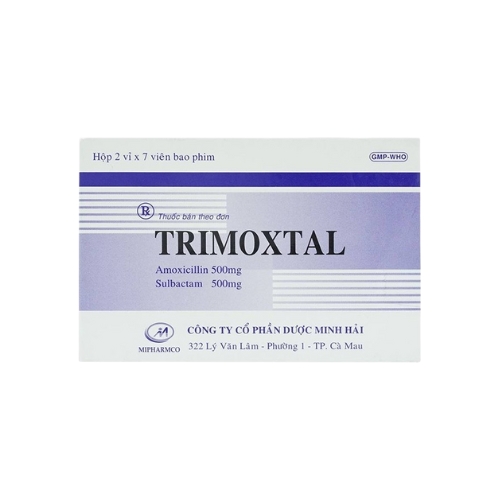
Trimoxtal Mipharmco medication for treating infections (2 blister packs x 7 tablets)
0001383051 reviews 27 comments
|
Category |
Antibiotic |
| Registration Number | VD-20159-13 |
| How to check licensed drug registration numbers | |
|
Dosage form |
Film-coated tablets |
|
Packaging |
Box of 2 blister packs x 7 tablets |
|
Ingredients |
Amoxicillin, Sulbactam |
|
Manufacturer |
Minh Hai |
|
Country of Manufacture |
Vietnam |
|
Brand Origin |
Vietnam |
|
Prescription required |
Yes |
|
Brief Description |
Trimoxtal 500/500 by Minh Hai Pharmaceutical Joint Stock Company, with main ingredients amoxicillin and sulbactam, is a medicine used to treat the following infections: Oral and respiratory infections, abdominal infections, gynecological infections, urinary tract infections, skin and soft tissue infections. |
|
Target users |
Eldery, Children |
|
Note |
This product is only sold with a doctor’s prescription; all information on the website is for reference only. |
Ingredients of Trimoxtal
Composition per 1 tablet
|
Ingredients |
Amount |
|---|---|
|
Amoxicillin |
500mg |
|
Sulbactam |
500mg |
Uses of Trimoxtal
Indications
Trimoxtal 500/500 is indicated for use in the following cases:
Treatment of the following infections:
-
Oral and respiratory infections (especially severe or recurrent cases): Otitis media, sinusitis, tonsillitis, pharyngitis, laryngitis, tracheitis, pneumonia, bronchitis…
-
Abdominal infections, gynecological infections.
-
Urinary tract infections: Especially in recurrent cystitis or complicated cases.
-
Skin and soft tissue infections: Lymphangitis, cellulitis, open or tissue-loss wounds, dental abscesses, and oral infections caused by Staphylococcus aureus.
Pharmacodynamics
Oral bioavailability reaches 90% compared to the equivalent intravenous dose of sulbactam and amoxicillin.
Biochemical studies with cell-free bacterial systems have shown that sulbactam can irreversibly inactivate most key beta-lactamase enzymes of penicillin-resistant bacteria. Sulbactam has significant antibacterial activity against Neisseriaceae, Acinetobacter calcoaceticus, Bacteroides spp, Branhamella catarrhalis, and Pseudomonas cepacia.
Microbiological studies on resistant bacterial strains confirm that sulbactam can protect penicillin and cephalosporins from bacterial destruction and synergize effectively with them. Because sulbactam also binds to some penicillin-binding proteins, using sulbactam-amoxicillin combinations is more effective for some sensitive bacterial strains than using a single beta-lactam.
The combination of sulbactam with amoxicillin kills sensitive bacteria by inhibiting mucopeptide synthesis in the cell wall.
The drug has a broad antibacterial spectrum against both Gram-positive and Gram-negative bacteria, including Staphylococcus aureus and S. epidermidis (including penicillin-resistant and some methicillin-resistant strains), Streptococcus pneumoniae.
Pharmacokinetics
Taking the drug after meals does not affect systemic bioavailability. Peak plasma concentrations of amoxicillin after oral combination therapy are twice as high as the same oral amoxicillin dose. Sulbactam’s half-life is 0.75 hours, and amoxicillin’s is 1 hour, with 50–75% excreted unchanged in urine.
Half-life increases in elderly and renal-impaired patients. Probenecid reduces renal tubular excretion of both amoxicillin and sulbactam, increasing and prolonging their blood concentrations when used together.
Sulbactam and amoxicillin penetrate most tissues and body fluids easily. The drug minimally penetrates the brain and cerebrospinal fluid unless meningitis is present.
Approximately 20% of amoxicillin and 40% of sulbactam bind to plasma proteins.
Most sulbactam and amoxicillin are excreted unchanged in urine.
The drug crosses the placental barrier and is excreted in breast milk.
How to use Trimoxtal
Administration
Take orally.
Dosage
Typical adult and children over 12 years:
Take 1 tablet per dose, 3 times daily.
Renal-impaired patients
Adult dose:
|
Creatinine clearance |
Dose |
|
> 30 ml/ minute |
No adjustment needed |
|
From 10 to 30 ml/minute |
Initial dose 1 g, then 500 mg every 12 hours |
|
< 10 ml/minute |
Initial dose 1 g, then 500 mg daily |
Children dose:
|
Creatinine clearance |
Dose |
|
> 30 ml/minute |
No adjustment needed |
|
From 10 to 30 ml/minute |
25 mg/kg, 2 times/day |
|
< 10 ml/minute |
25 mg/kg/day |
Note: The above dosages are for reference only. The exact dose depends on the patient’s condition and disease severity. Consult a doctor or healthcare professional for the appropriate dose.
Overdose
No reports of amoxicillin-sulbactam overdose exist. In case of overdose, stop taking the drug immediately and use supportive treatments. Inducing vomiting or gastric lavage may be considered if recent, unless contraindicated.
No specific antidote exists; the drug can be removed via hemodialysis.
Missed dose
Take the missed dose as soon as possible. If it is near the next dose, skip the missed dose and continue the normal schedule. Do not double the dose.
Side effects
Using Trimoxtal 500/500 may cause adverse reactions (ADR).
Common, ADR > 1/100:
Nausea, vomiting, diarrhea, indigestion, epigastric pain.
Uncommon, 1/1000 < ADR < 1/100:
Allergic reactions: Hives, angioedema, urticaria, respiratory disorders, rarely anaphylactic shock.
Interstitial nephritis.
Hematologic reactions: Anemia, platelet disorders, leukocyte disorders.
Liver: Liver function disorders.
Candida infections in the mouth or other sites due to microbial imbalance.
Rare: Stevens-Johnson syndrome, erythema multiforme, toxic epidermal necrolysis. Hyperactivity, anxiety, insomnia, behavioral changes.
Some cases of pseudomembranous colitis.
ADR management:
Report any adverse effects to a doctor.
Note
Read the instructions carefully before use and consider the following information.
Contraindications
Trimoxtal 500/500 is contraindicated in:
-
Patients with a history of allergy to penicillin, cephalosporins, sulbactam, or any component of the drug.
-
History of gastrointestinal disease.
-
Infections with mononucleosis.
-
Herpes virus infection.
-
Patients treated with allopurinol.
-
Pregnant or breastfeeding women.
-
Children under 12 years old.
Precautions
Patients may develop fungal or bacterial superinfections (mainly Pseudomonas or Candida). Discontinue use and apply appropriate treatment if this occurs.
Treatment may increase liver transaminase levels, mainly AST.
Mild decrease in correlation between estriol/estrone and estradiol levels. Use additional contraception if the patient is using estrogen/progestin contraceptives.
Regular liver and kidney function monitoring is needed for prolonged use.
Use caution in the elderly, children, pregnant or breastfeeding women.
Ability to drive and operate machinery
No data found in pharmacological references.
Pregnancy
Use with caution in pregnant women.
Breastfeeding
Use with caution in breastfeeding women.
Drug Interactions
Concurrent use with allopurinol increases risk of skin allergic reactions.
Probenecid can increase blood levels by reducing renal excretion.
Chloramphenicol, macrolides, sulfonamides, and tetracyclines may interfere with penicillin’s bactericidal effect.
Laboratory: Amoxicillin may affect total serum protein levels or cause false-positive urine glucose tests. High amoxicillin concentrations may lower blood glucose.
Storage
Store below 30°C in a cool, dry place, away from light.
Keep out of reach of children.