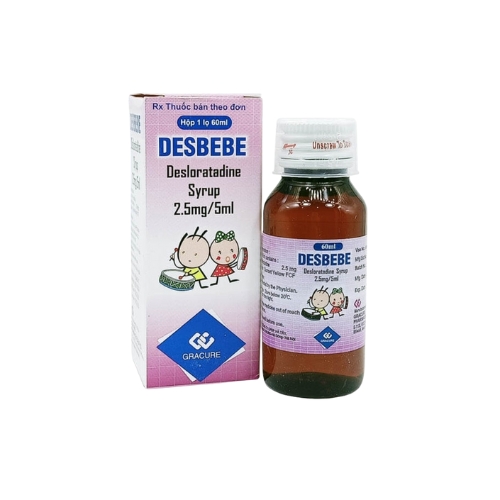
DESBEBE
What is Desbebe Syrup 2.5mg/5ml?
|
Dosage |
Syrup |
|
Packaging |
Box containing 1 bottle x 60ml |
|
Ingredient |
Desloratadina |
|
Manufacturer |
Gracure Pharmaceuticals |
|
Manufacturing Country |
India |
|
Brand Origin |
India |
|
Prescription required |
Yes |
|
Brief description |
Desbebe 2.5mg/5ml is a product of Gracure Pharmaceuticals Ltd, containing Desloratadine, which is effective in treating symptoms of seasonal or perennial allergic rhinitis and chronic urticaria. |
Ingredients of Desbebe Syrup 2.5mg/5ml
Ingredients per 5ml
|
Thông tin thành phần |
Amount |
|---|---|
| Desloratadine |
2.5mg |
Uses of Desbebe Syrup 2.5mg/5ml
Indications
Desbebe 2.5 mg/5 ml is indicated for the following conditions:
- Seasonal allergic rhinitis: Desbebe is indicated to rapidly relieve the symptoms of seasonal allergic rhinitis in patients aged 2 years and older.
- Perennial allergic rhinitis: Desbebe is indicated to rapidly relieve the symptoms of perennial allergic rhinitis in patients aged 2 years and older.
- Chronic idiopathic urticaria: Desbebe is indicated to rapidly relieve itching and reduce the number and size of hives in patients with chronic idiopathic urticaria aged 2 years and older.
Pharmacodynamics
Desloratadine is a selective, long-acting, non-sedating histamine H₁-receptor antagonist. After oral administration, desloratadine selectively inhibits peripheral H₁ receptors because it does not penetrate the central nervous system.
In in-vitro studies, desloratadine has been shown to exhibit anti-allergic properties.
These include inhibiting the release of pro-inflammatory cytokines such as IL-4, IL-6, IL-8, and IL-13 from mast cells/basophils, as well as inhibiting the expression of adhesion molecules such as P-selectin on endothelial cells.
The clinical relevance of these findings is still being confirmed.
Pharmacokinetics
Absorption
Plasma concentrations of desloratadine can be detected within 30 minutes after oral administration in adults and adolescents. Desloratadine is well absorbed, reaching peak plasma concentration approximately 3 hours after dosing, with a terminal half-life of about 27 hours. The accumulation of desloratadine is consistent with its half-life (around 27 hours) and the once-daily dosing regimen. The bioavailability of desloratadine is proportional to the dose in the range of 5–20 mg.
Distribution
Approximately 82%–87% of desloratadine and 85%–89% of 3-hydroxydesloratadine are bound to plasma proteins. Protein binding for both desloratadine and 3-hydroxydesloratadine is unchanged in individuals with renal impairment.
Metabolism
Desloratadine (the primary active metabolite of loratadine) is extensively metabolized to 3-hydroxydesloratadine, an active metabolite, which is then glucuronidated. The enzymes responsible for the formation of 3-hydroxydesloratadine have not been identified. Clinical data indicate that a small fraction of patients have a reduced ability to form 3-hydroxydesloratadine, resulting in slower desloratadine metabolism. In pharmacokinetic studies (n = 3748), approximately 6% of subjects were identified as poor metabolizers of desloratadine (defined as having a 3-hydroxydesloratadine-to-desloratadine AUC ratio <0.1, or a desloratadine half-life exceeding 50 hours).
These studies included subjects aged 2–70 years, with 977 subjects aged 2–5 years, 1575 aged 6–11 years, and 1196 aged 12–70 years. No age-related differences in the prevalence of poor metabolizers were observed. The frequency of poor metabolizers was higher in Black individuals (17%, n = 988) than in Caucasians (2%, n = 1462) and Greeks (2%, n = 1063). The mean plasma AUC of desloratadine in poor metabolizers was approximately six times greater than in non–poor metabolizers. Poor metabolizers cannot be identified in advance and will exhibit higher desloratadine plasma exposure even when using the recommended dose.
In multiple-dose safety studies where metabolizer status was determined, 94 poor metabolizers and 123 normal metabolizers were treated with desloratadine for 15–35 days. No overall differences in safety were observed between poor and normal metabolizers. Although no dedicated pharmacokinetic studies are available for this population, poor metabolizers may be more sensitive to dose-related adverse effects.
Elimination
The average half-life of desloratadine is 27 hours. Cmax and AUC values increase proportionally with the single-dose range of 5–20 mg. Accumulation after 14 days of dosing is consistent with the half-life and dosing frequency. A human mass-balance study showed approximately 87% recovery of a radiolabeled ^14C-desloratadine dose in urine and feces as metabolites. Plasma analysis of 3-hydroxydesloratadine showed similar Tmax and half-life values compared with desloratadine.
How to use Desbebe Syrup 2.5mg/5ml
How to use
Take orally. Desbebe should be administered in age-appropriate doses using a dropper or syringe to measure 2 to 2.5 mL (1/2 teaspoon).Dosage
Recommended doses:
- Adults and children over 12 years old: The recommended dose is 2 full teaspoons (5 mg in 10ml) once daily.
- Children 6 to 11 years old: The recommended dose is 1 full teaspoon (2.5mg in 5ml) once daily.
- Children 2 to 5 years old: The recommended dose is 1/2 teaspoon (1.25mg in 2.5ml) once daily.
- For patients with hepatic or renal impairment, the recommended dose of desloratadine is 5 mg every other day.
What to do in case of ?
In the event of an overdose, standard measures should be taken to remove any unabsorbed drug from the body.Symptomatic and supportive treatment should be provided as needed.
Based on clinical trials with various doses in adults and adolescents, with doses up to 45 mg of desloratadine (9 times the usual dose), no clinically relevant adverse effects were observed.
Desloratadine cannot be eliminated by hemodialysis, and it is unknown whether peritoneal dialysis can remove the drug.
What to do if you miss a dose?
Take the missed dose as soon as you remember. However, if it is close to the time of the next dose, skip the missed dose and continue as scheduled. Do not take a double dose to make up for the missed one.Adverse effects
In clinical trials involving a total of 246 children aged 6 months to 11 years who received desloratadine syrup, the overall incidence of adverse effects in children aged 2 to 11 years was similar between the desloratadine group and the placebo group. In infants and young children aged 6 to 23 months, most adverse effects reported after taking desloratadine syrup included diarrhea (3.7%), fever (2.3%), and insomnia (2.3%).
At the recommended dose, in clinical trials involving adults and adolescents for indications such as allergic rhinitis and chronic idiopathic urticaria, adverse effects with desloratadine were reported in 3% of patients, compared with placebo.
Most of the adverse effects reported more frequently than with placebo were fatigue (1.2%), dry mouth (0.8%), and headache (0.6%).
Other very rare adverse reactions reported during post-marketing surveillance are listed as follows:
- Hepatobiliary disorders: Elevated liver enzymes, increased bilirubin, hepatitis.
- Musculoskeletal and connective tissue disorders: Myalgia.
- General disorders: Hypersensitivity reactions (such as allergy, angioedema, difficulty breathing, rash, itching, and hives).
Inform your doctor if you experience any side effects related to the use of this medicine.
Note
Before using this medicine, you should carefully read the instructions and refer to the information below.
Contraindications
Desbebe 2.5mg/5ml is contraindicated in the following cases:
Do not use in patients who are hypersensitive to desloratadine or any component of the medicine.
Precautions
Use desloratadine with caution in patients with a history of epilepsy.
Care should be taken when taking desloratadine as hypersensitivity reactions to the ingredients may occur, such as rash, itching, hives, swelling, or difficulty breathing. If such reactions occur, discontinue desloratadine and switch to an alternative treatment.
Due to the sucrose content, this medicine should not be used in patients with fructose intolerance, glucose-galactose malabsorption, or sucrase-isomaltase deficiency.
The presence of sunset yellow FCF (colour additive) may cause allergic reactions, so caution is advised.
Effects on ability to drive and use machines
Exercise caution when driving or operating machinery as the medicine may cause adverse effects such as dizziness or drowsiness.
Use in pregnancy and breastfeeding
Pregnancy
Desloratadine did not cause birth defects in rats at doses of 48 mg/kg/day (estimated to be approximately 210 times the human therapeutic AUC based on the recommended daily oral dose of Desloratadine and its metabolites) or in rabbits at doses of 60 mg/kg/day (estimated to be approximately 230 times the human therapeutic AUC based on the recommended daily oral dose).
Use of Desloratadine at 9 mg/kg/day or higher in pregnant dogs caused reduced body weight and delayed pupillary light reflex (estimated to be approximately 50 times the human therapeutic AUC based on the recommended daily oral dose of Desloratadine and its metabolites). Desloratadine did not affect fetal development in dogs at 3 mg/kg/day (estimated to be approximately 7 times the human therapeutic AUC based on the recommended daily oral dose).
However, adequate and well-controlled studies in pregnant women have not been conducted. Because animal reproductive studies do not always predict human response, Desloratadine should be used during pregnancy only if clearly needed.
Breastfeeding
Desloratadine is excreted in human breast milk; therefore, a decision should be made to either discontinue breastfeeding or discontinue Desloratadine, taking into account the importance of the drug to the mother.
Drug Interaction
Desloratadine can increase the levels and effects of alcohol, anticholinergic drugs, central nervous system depressants, and selective serotonin reuptake inhibitors (SSRIs).
The concentration and effects of Desloratadine may be increased by droperidol, hydroxyzine, P-glycoprotein inhibitors, and pramlintide.
Desloratadine can decrease the concentration and effects of acetylcholinesterase inhibitors, benzylpenicilloyl polylysine, betahistine, amphetamines, and P-glycoprotein inducers.
Food does not affect the bioavailability of Desloratadine.
There is potential for pharmacokinetic interactions between Desloratadine and drugs affecting liver microsomal metabolic enzymes, such as azithromycin, cimetidine, erythromycin, fluoxetine, and ketoconazole.
However, no clinically significant changes in ECG, vital signs, or adverse effects have been observed.
Storage
Store in a cool place, protected from light, at a temperature below 30°C.
Keep out of reach of children. Read the instructions carefully before use.
|
Note |
This product is only sold with a doctor’s prescription. All information on the website is for reference purposes only. |