



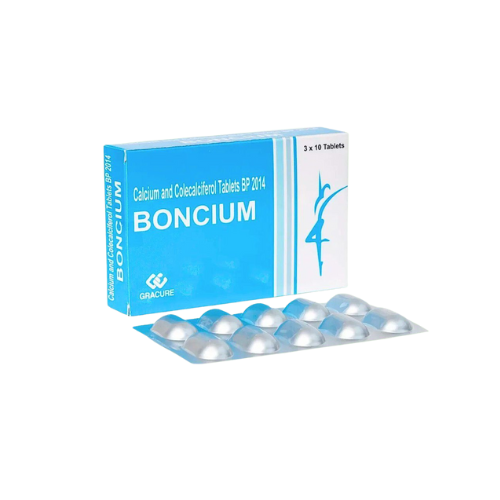
BONCIUM
What is Boncium?
Ingredients of Boncium
Ingredients per tablet
|
Ingredients |
Amount |
|---|---|
|
Calcium carbonate |
1250mg |
|
Cholecalciferol |
250iu |
Uses of Boncium
Indications
Boncium 1250 mg gracure 3x10 is indicated for use in the following cases:
Prevention and treatment of calcium and vitamin D3 deficiency in adults, such as osteoporosis, pregnant women, and breastfeeding mothers.
Pharmacology
Calcium is the fifth most abundant element in the body, mostly found in bones. The skeletal system contains about 90% of the body's calcium.
Calcium salts play an important role in regulating the permeability of cell membranes to sodium and potassium ions, maintaining mucosal integrity, and cell adhesion. Increased calcium levels reduce permeability, and vice versa. Calcium carbonate is the form with the highest calcium content (40%).
Vitamin D3, along with parathyroid hormone and calcitonin, regulates calcium levels in the blood. The main biological function of vitamin D3 is to maintain normal calcium and phosphorus levels in plasma by enhancing the absorption of minerals from the diet in the small intestine.
Pharmacokinetics
Calcium is absorbed in the upper part of the small intestine. In healthy adults, about one-third of the ingested amount is absorbed. Vitamin D3 increases the absorption of calcium and phosphate from the intestines while mobilizing calcium into the bones. Vitamin D3 stimulates phosphate absorption from the intestines, which contributes to its effect on calcium transport.
In plasma, 40% of calcium is bound to proteins, 10% forms complexes with anions such as citrate and phosphate, and the rest is present as free calcium ions, phosphate in plasma, intracellular fluid, collagen, and bone tissue.
Calcium is excreted through the digestive system via saliva, bile, and pancreatic fluids into the feces. It is also significantly excreted in breast milk and sweat, and eliminated in urine, which is related to sodium excretion. Calcium is reabsorbed in the proximal tubules under the influence of PTH and in the distal tubules under the influence of vitamin D3.
Vitamin D3 is well absorbed orally from the small intestine. Bile is necessary for vitamin D3 absorption. Because vitamin D3 is fat-soluble, it is concentrated in chylomicrons and absorbed via the lymphatic system; approximately 80% of orally administered vitamin D3 is absorbed this way. Vitamin D3 and its metabolites circulate in the blood bound to specific alpha-globulin. The plasma half-life of vitamin D3 is 19–25 hours, but it is stored for a long time in fat tissues.
Vitamin D3 is hydroxylated in the liver to form 25-hydroxycholecalciferol. This compound is further hydroxylated in the kidneys to form the active metabolites 1,25-dihydroxycholecalciferol and the derivatives 1,24,25-trihydroxy.
The liver converts vitamin D3 into 25-OHD, which binds to proteins and circulates in the blood. In fact, 25-OHD has a higher protein affinity than the parent compound. The 25-hydroxy derivative has a half-life of 19 days and is the main form of vitamin D3 in the blood. The steady-state concentration of 25-OHD is 15–50 nanograms/ml.
Vitamin D3 and its metabolites are mainly excreted in bile and feces, with only a small amount appearing in urine.
How to use Boncium
Usage
Boncium 1250 mg gracure 3x10 is an oral medication.
Dosage
1 tablet twice a day.
It is not recommended to use for more than 1 month without a doctor’s instruction.
No dose adjustment is required for patients with liver impairment.
Note: The above dosage is for reference only. The specific dosage depends on the patient’s condition and disease progression. To determine the appropriate dose, consult a doctor or healthcare professional.
What to do in case of overdose?
Signs
Vitamin D3 toxicity may occur with high or prolonged doses, or with increased sensitivity to normal doses of vitamin D3, leading to clinical manifestations of calcium metabolism disorders. Some children may have heightened reactions even to small amounts of vitamin D3. In adults, vitamin D3 toxicity can result from overdosing in cases of hypoparathyroidism or excessive self-administration of very high doses of vitamin D3. Accidental ingestion of adult doses by children can also cause toxicity.
The amount of vitamin D3 that causes toxicity varies between individuals. Generally, people with normal parathyroid function and normal sensitivity to vitamin D3 who take 50,000 IU/day or more continuously may experience vitamin D3 poisoning. Vitamin D3 toxicity is particularly dangerous for people taking digitalis, as the toxicity of cardiac glycosides increases with elevated blood calcium.
Early signs and symptoms of vitamin D3 poisoning are those of hypercalcemia (see adverse effects).
Management
Stop the medication, stop calcium supplementation, maintain a low-calcium diet, drink plenty of water, or receive intravenous fluids. If necessary, corticosteroids or other medications, especially calcium-excreting diuretics (such as furosemide and ethacrynic acid), may be used to reduce serum calcium levels. Hemodialysis or peritoneal dialysis can be used to remove free calcium from the body.
In cases of acute vitamin D3 poisoning, if recently ingested, further absorption can be prevented by inducing vomiting or gastric lavage. If the drug has passed into the stomach, treatment with mineral oil can promote excretion of vitamin D3 through feces. Because 25-OH metabolites of cholecalciferol accumulate in the body, hypercalcemia may persist for 2 months or longer after long-term treatment with high doses of these medications.
What to do if a dose is ?
If you forget to take a dose, take it as soon as you remember. However, if it is close to the next scheduled dose, skip the missed dose and take the next dose at the planned time. Do not take a double dose.
Side Effects
When using Boncium 1250 mg gracure 3x10, you may experience adverse reactions (ADRs).
Rare digestive disorders.
High doses may lead to hypercalcemia and vitamin D3 toxicity with the following possible side effects:
Common, ADR > 1/100
- Nervous system: Weakness, fatigue, drowsiness, headache.
- Digestive: Loss of appetite, dry mouth, metallic taste, nausea, vomiting, abdominal cramps, constipation, diarrhea, dizziness.
- Other: Tinnitus, loss of coordination, rashes, decreased muscle tone, muscle pain, bone pain, irritability.
Uncommon, 1/1000 < ADR < 1/100
- Urinary-genital: Reduced libido, kidney calcium deposits, kidney dysfunction (leading to polyuria, nocturia, excessive thirst, low urine density, proteinuria).
- Other: Runny nose, itching, osteoporosis in adults, stunted growth in children, weight loss, anemia, calcific conjunctivitis, light sensitivity, widespread calcification, pancreatitis, vascular calcification, seizures.
Rare, ADR < 1/1000
- Cardiovascular: Hypertension, arrhythmia.
- Metabolic: May increase urinary calcium, phosphate, albumin, blood urea nitrogen, serum cholesterol, AST (SGOT), and ALT (SGPT).
- Decreased serum alkaline phosphatase.
- Other: Severe psychiatric disorders, electrolyte imbalances with mild acidosis, digestive disorders.
Guidance for Managing ADRs
If side effects occur, stop using the medication and inform a doctor or visit the nearest healthcare facility for timely management.
Note
Before using this medication, read the instructions carefully and consider the following information.
Contraindications
Boncium 1250 mg gracure 3x10 is contraindicated in the following cases:
- Hypersensitivity to any component of the drug.
- Patients with kidney failure, hypercalcemia, hyperparathyroidism, or hypercalciuria.
- Individuals with kidney stones or vitamin D toxicity.
Cautions
Do not use simultaneously with the antibiotic ceftriaxone.
Avoid use if hypercalcemia is present or if prone to kidney stones.
Exercise caution when using calcium salts in patients with kidney disease, heart disease, or sarcoidosis.
Do not use calcium preparations together with digoxin.
Monitor blood calcium, urinary calcium, and kidney function during long-term use; risk of hypercalcemia in bedridden osteoporosis patients; do not combine with other preparations containing calcium and vitamin D.
Ability to Drive and Operate Machinery
Does not affect the ability to drive or operate machinery.
Pregnancy
This medication can be used by pregnant women.
If vitamin D3 is used at doses higher than the recommended daily allowance (RDA) for normal pregnancy (400 IU), there may be risks; therefore, vitamin D3 should not be used above the RDA for pregnant women. Prolonged maternal hypercalcemia during pregnancy has been associated with aortic valve stenosis, kidney disease, delayed mental development, and/or delayed physical growth in infants and young children. Hypercalcemia during pregnancy can also reduce parathyroid hormone levels in newborns, leading to hypocalcemia, seizures, and epilepsy.
If dietary intake of vitamin D3 is insufficient or there is limited exposure to ultraviolet radiation, vitamin D3 supplementation up to the RDA is recommended during pregnancy.
Breastfeeding
This medication can be used by breastfeeding women.
Vitamin D3 is excreted in breast milk; therefore, vitamin D3 should not be used at doses higher than the RDA for breastfeeding women. Supplementary vitamin D3 is recommended if dietary intake is insufficient or there is limited exposure to ultraviolet radiation.
Caution is advised when supplementing vitamin D3 for breastfed infants.
Drug Interaction
The following drugs inhibit calcium excretion through the kidneys: thiazides, clopamide, ciprofloxacin, chlorthalidone, anticonvulsants.
Calcium reduces the absorption of demeclocycline, doxycycline, metacycline, minocycline, quinolones, iron, and other essential minerals.
Calcium increases the toxicity of cardiac glycosides, as elevated blood calcium levels enhance the inhibitory effect of glycosides on Na⁺-K⁺-ATPase.
Glucocorticoids and phenytoin reduce calcium absorption through the digestive tract. Diets high in phytates or oxalates reduce calcium absorption by forming poorly absorbable complexes.
Vitamin D3 should not be used simultaneously with cholestyramine or colestipol hydrochloride, as this may reduce intestinal absorption of vitamin D3.
Excessive use of mineral oil can interfere with vitamin D3 absorption in the intestines.
Concurrent treatment with vitamin D3 and thiazide diuretics in individuals with hypoparathyroidism may lead to hypercalcemia.
Vitamin D3 should not be used simultaneously with phenobarbital and/or phenytoin, as these drugs can reduce plasma levels of 25-hydroxycholecalciferol and increase the metabolism of vitamin D3 into inactive compounds.
Vitamin D3 should not be used concurrently with corticosteroids, as corticosteroids interfere with the effects of vitamin D3.
Vitamin D3 should not be used simultaneously with cardiac glycosides due to the risk of hypercalcemia, which may lead to arrhythmias.
Storage
Protect from light; store below 30°C.
Shelf life: 36 months from the date of manufacture. Do not use the medication after the expiration date printed on the package.
Manufacturer: Gracure Pharmaceuticals Ltd.